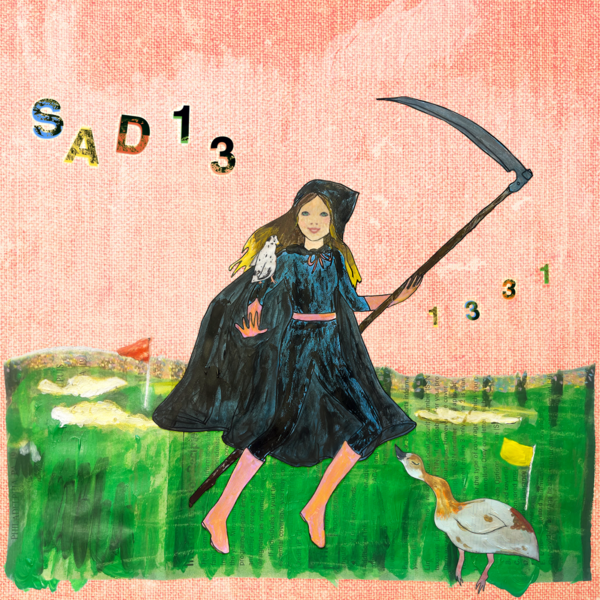
Flipping through photo book Protest Grim Reapers, Sadie Dupuis—guitarist and songwriter of lauded rockers Speedy Ortiz, who also produces electropop as Sad13—was struck by the versatility of Death. The cloak and scythe on a picket line looked grave but uncanny, even comic. Online, on tour, she saw deathly dissonance everywhere: in ”journalistic doublespeak, politeness politics, and Big Tech’s censorship,” she elaborates. 1331, Sad13’s bubbling new suite, reports on mortality and duality; it expands Dupuis’s diverse discography with ambitious, otherworldly home recordings in the surreal spirit of the reaper she painted as cover art.
1331 is a mixtape, a framing Dupuis found vital, as it takes the form of a sixteen-minute collage of thirteen brief-but-dense tracks. Though it’s her solo project, Sad13 pursuits often follow collaborations; 2016 glitter-pop debut Slugger came after co-writes with Lizzo, while 2020’s maximalist Haunted Painting spotlit teamwork with other women engineers, like Sarah Tudzin (Illuminati Hotties) and Maryam Qudus (Spacemoth). 1331’s spark was comedian Jamie Loftus’s Sixteenth Minute, one of several podcast themes Dupuis has scored. “I obsess over short songs—jingles, interludes, anything truncated that rewards more listens,” she says. “It’s addicting when hooks switch quickly and barely retread.” She cherishes this form’s experts: Guided By Voices, Tierra Whack, her former tourmate Mitski.
Besides a few older ones—like elegiac opener “I Am Now Completely Invisible,” which morphs JRPG chamber orchestration into wall-of-sound guitars—most of 1331 came in spring 2024, a patch Dupuis calls a “mini nervous breakdown.” Speedy Ortiz records are often personal-as-political, but 2023’s Rabbit Rabbit dealt with childhood abuse. Promoting it felt brutal, and she realized she needed further processing, distinct from songwriting. “Making music is magic, a hurts-so-bad-it’s-good potion,” she says. “But therapy is different, and I didn’t wanna mine it for more art.” She made it a goal to write daily songs around a minute long, a rewarding game to relieve challenges posed in counseling.
1331 trains its lens on Philly, Sad13’s home base of a decade. Solidarity encampments for Gaza are sketched with industrial layers on “Watermelon Manicure,” while Björkian groove “Art Institute” skewers colleges-as-corporations. Activists for housing and trans rights were deploying insects, admired on alt-R&B soundscape “Locust Releaser,” while a hated mayor gets the poison pen on “People’s Loser.” Communality doesn’t detract from introspection: on more pensive songs, Dupuis plays villains, monstrifying ego with fizzy bop “Six Ways” and lamenting leftist factionalism on shimmery “Mean, Vindictive, Arrogant” (“If it’s all I can do not to fight you / then it’s all I can do not to win,” it concludes). She shares: “I wrote Steely Dan-type caricatures of myself, because what I’m bothered by in others is usually something I should change, too.”
Philadelphia infrastructure affected the mixtape another way—a bicycle accident shattered her elbow in June 2024, requiring reconstructive surgeries and a year of rehab. After twenty-plus years of playing, Rolling Stone had recently included Dupuis in their Greatest Guitarists of All Time, and the Rock & Roll Hall of Fame was displaying her guitar. Suddenly, doctors warned she might never play again. Grueling training put her back on tour in September, but nerve damage kept her off the computer, postponing Sad13 recording. “My body didn’t have the juice,” she recalls. “But tracking in little bursts over more time gave me broader influences.” Those included gigs attended while in recovery: Rebecca Black, Cloakroom and tourmate Baths invited inspiration, alongside basement shows and beat-forward nightlife soundtracks. And despite her miraculous return to riffs, they’re decorative on 1331: “I’ve made a lot of records where guitar is the star. Validation for my playing let me relax a bit, so other timbres could shine,” she says.
Guitars aren’t gone—1331 boasts jazz voicings, feedbacking leads, no-wave skronk—but they are decentralized. Drums were a starting point, programmed entirely from samples, and Sad13 songs always pulse with synths, citing circuitry from Gary Numan to PinkPantheress. Dupuis interspersed field recordings (birds, clocks, a guided meditation), and prioritized nimble bass after seeing the Brandee Younger Trio. Though 2013 Speedy breakthrough Major Arcana foregrounded ‘90s-slacker speak-sing, Dupuis is extensively trained; she once toured internationally in a classical choir, and works backing vocal sessions in rap, folk, and rock. “I learned to sing in groups, and still learn from blending with others, so I brought those lessons here,” she says. In her home studio’s seclusion, she tapped bonus styles: whistle voice, shredding screams, operatic runs, across a huge range surpassing three octaves.
Dupuis made 1331 totally DIY, the sole performer and recording engineer for the first time in fifteen years. Since Sad13’s inception, it’s played live as a band—including worldwide festivals like Glastonbury, and U.S. tours with Deerhoof and Vagabon—but the mixtape mindset made Dupuis eager to experiment alone. “I wanted to stoke chaos and plumb rabbit holes, not make my friends tidy after me,” she explains. She’s not without contributors: Emily Lazar, Sad13’s day-one mastering engineer (HAIM, Olivia Rodrigo), worked holistically, bringing boom to snares and nuance to subs. And Exploding In Sound, whose debut vinyl release was also Speedy’s first, is again her label. “I forever admire their curation and ethics. From Grass Is Green to Jobber, EIS presses my best buds’ records, and also my favorites,” she enthuses.
Like many working musicians, Dupuis juggles freelance jobs, and one of 1331’s motifs is media burnout. “Pretty Little Lifers” is anti-folk about generations of music industry exploitation, contextualized by Dupuis’s organizing with United Musicians and Allied Workers, while fuzzy “Friend of the P” mocks unseen labor accompanying public-facing roles. (“My contribution to the discourse / is to shut the fuck up,” she deadpans.) Dupuis is a poet with two treasured collections, and she brings literary analysis to the mixtape’s title: “1331 signifies palindromes, mirrors, warped balance,” she clarifies. “It’s a mash-up of two ages in the lyrics. The first, as in my alias ‘sad thirteen,’ represents teenage moodiness, while thirty-one bookmarks young adulthood, which brought me more radical clarity.”
1331 melds mindsets and melodies across time: whimsical fun amid noisy fury, sophisticated balance shaping wild catharsis. It’s concise, delightfully weird music, a catchy rush that’s distinctly Sad13. Much like a grim reaper at a march, 1331 calls out foes in a winking costume, all with hope for future joy. Sixteen minutes of poignant music is a great place to start, and if that’s not long enough? “You can always hit repeat,” offers Dupuis.