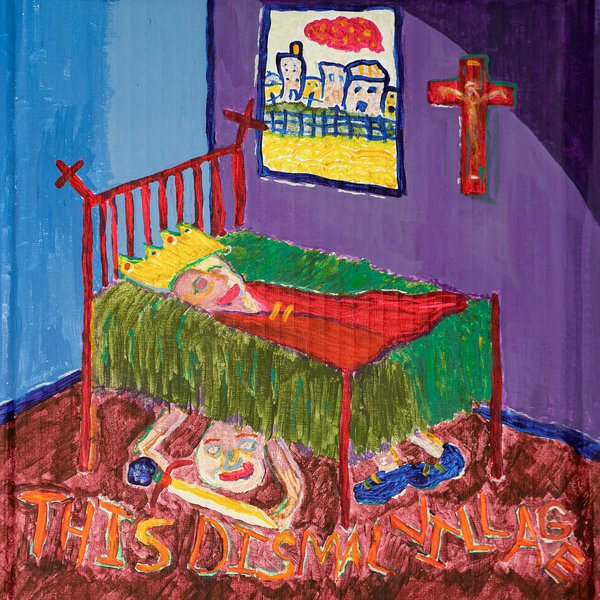
Venturing into “a limbo world between medieval tropes and modern-day decay,” New Orleans musician Urq (half of art punk duo Spllit) returns with a new solo offering. Recorded over a single, intense month, This Dismal Village is a homespun document that sits somewhere between jittery punk, dreary psychedelia, and hooky bedroom pop. Recorded to 4-track, the record embraces limitation as a creative engine, resulting in a sound that is raw, unsettled, and deeply atmospheric.
The album is set not in a fixed point in time or geography, but a liminal environment where dystopic visions and archaic fixtures exist side by side. In the dismal village, kings and witches share space with televisions, skyscrapers, and modern enterprise; organ fanfares echo down streets populated by disgruntled townsfolk and whispered gossip. It is simultaneously the dark ages, 1950s suburbia, and a 21st-century metropolis. Embracing anachronism was central to the project’s identity, an attempt to collapse history into a single, uneasy present.
After stumbling upon a serendipitous online listing for a cassette Portastudio, Urq made the decision to commit fully to the format. Working on cassette fundamentally changed the writing process. Accustomed to building songs incrementally and reshaping them through digital editing, the limitations of 4-track meant he had to adapt to a more deliberate approach. The songs became simpler, more direct, and less “wacky” or robotic than previous releases. Imperfections are not just audible but essential.
Another facet of the record is that each song on the album was conceived as a specific location within the dismal village. ‘Another Mystery’, for instance, serves as the imposing house on the hill. Inspired in part by Shirley Jackson’s We Have Always Lived in the Castle, it channels the dread of a place everyone avoids, the house kids dare each other to approach. In the album’s loose narrative, rumors swirl through the village: talk of horrific crimes, killers on the loose, and secrets no one can quite confirm. As the first song recorded, it set the tone and aesthetic for everything that followed.
Elsewhere ‘Kings in Bed’ represents the castle. Built around a few looping chords generated by an iPhone app, emulating a quirky 1960s instrument called the Optigan that played preset musical loops, the song captures the album’s bleak sense of inevitability. Spacious but always on the edge of falling apart, it’s a slow-crawl through four-and-a-half minutes of self-defined “dreary-psychedelia”, the track tying together many of the record’s themes: power, decay, and the quiet horror of events unfolding beyond anyone’s control.
The album’s title-track ‘This Dismal Village’, should be viewed as the opera house. Drawing inspiration from Werner Herzog’s Fitzcarraldo, the song introduces an outsider with a savior complex, intent on “civilizing” the village according to their own vision. Structurally complex and emotionally dense, it’s a far gnarlier and somewhat darker affair than the other aforementioned singles, the track reflects on “urban renewal” and the so-called unstoppable march of progress imposed by those who believe they know better.
The technical challenges of recording to cassette were constant but invigorating. From narrowly avoiding accidental erasures to meticulously planning track bounces, every decision mattered. Like the final few pieces of a sprawling jigsaw puzzle, songs had to be recorded in precise orders for everything to fall into place. These obstacles became part of the fun, reinforcing the album’s sense of urgency and commitment. The album also features an alternate guitar tuning, one Urq dubbed as “the dismal tuning”. Used on every track except the closer, the downtuned, unstable tuning produces uncanny, gloomy chords, with strings that slip out of tune if played too aggressively, adding to the record’s sense of encroaching unease.
Sonically and philosophically, the album sits firmly in the tradition of rough and raw cassette rock. Guided By Voices’ Bee Thousand looms large as an influence, particularly its ability to build an entire world through unpolished, first-take recordings. Robert Pollard’s idea of the “four P’s” (psych, punk, prog, and pop) serves as a neat summary of the artist’s musical instincts and each element can be traced right through the heart of This Dismal Village.
Further inspiration comes from post-punk’s so-called “Calgary Sound,” a loose movement blending psych pop, post-punk, and math/prog elements with a home-recorded, unpretentious ethos. Bands like Palm, Surface to Air Missive, and Jake Tobin informed the album’s balance of complexity and casualness. And beneath the freak-rock exterior, traces of 90s alt-rock melodrama remain: the 4-track demos of Rivers Cuomo and the sweeping melodies of Mellon Collie and the Infinite Sadness quietly prickle away at the record’s edges.
The result is an album that unrolls like a place wandered through, uneasy, occasionally familiar, and impossible to pin down in time. All captured on tape before it could disappear like an apparition, like a dream only half-remembered.
Bio: Tom Johnson
Photo: Emma Ledgerwood